It was called Operation Big Bang – a large scale disaster exercise providing emergency response organisations and Lowes Petroleum staff to undertake annual crisis training.
Last week Lowes Petroleum safety team and executives, together with 30 ambulance, firefighters and police personnel from the St George command regional area, conducted a large-scale emergency drill at the company’s St George Depot.
The exercise provided a realistic incident: an explosion of a small gas cylinder located on the back of a caravan at the Lowes BP fuelling station: with two deaths, multiple casualties, and a large area lockdown.
Keeping it real, the initial dispatch detailed an explosion, resulting in evident structural damage without revealing the details of patients and injuries on scene, with multiple callers reporting the incident.
-
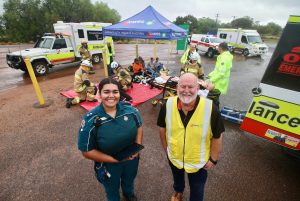
- Lowes Petroleum HSSE General Manager Bernie Morris with Hanna Pakoa from Queensland Ambulance St George.
Lowes Petroleum’s HSSE* General Manager Bernie Morris said an opportunity presented itself for Lowes Petroleum to conduct its annual ‘catastrophic incident drill’ together with St George’s Queensland Ambulance Service (QAS) annual training exercise.
“We take safety incredibly seriously,” Mr Morris said. “We can never be complacent that an incident will never happen to us. We undertake annual drills, and it worked out perfectly that we could do that with local rescue authorities allowing both parties to access our response capacities and also how we work with relevant authorities.
“This training provides invaluable opportunities to explore learning opportunities allowing the QAS to manage a large-scale event beyond their daily response capabilities.
“While it allowed QAS to utilise SMART Triage tags in a real time environment, it also created interaction with other emergency agencies and an opportunity for the Lowes Petroleum team to understand how we can assist and support them in a large-scale event.”
When you are hauling fuel through some of the most remote and often dangerous roads in Australia, mitigating risks and ensuring safety is first and foremost.
“We practise scenarios at least once a year if not twice,” Mr Morris said. “St George is a part of a major transport throughfare and like most rural communities, essential resources can be quickly stretched and easily overwhelmed when presented with a mass casualty incident.
“An exercise like this allows us invaluable insights to what to expect should a situation arise but to also ensure our crisis management/action plans are realistic and practical.
“Our relationship with all emergency services, is critically important to us. So, this partnership in a training session on our property is incredibly valued.”
*Health, Safety, Security and Environment
