A decision in a case before the full Federal Court this week has clarified what a business needs to do in order to make a compliant ‘request to work a public holiday’ from their employees – and it is significantly more than putting forward a roster and assuming that staff will work the public holiday.
“The case in question hinged around two elements; was a request to work the public holiday compliantly made, and was any refusal to work the public holiday made by the employee reasonable. The outcome of the case has had little impact on the second element, that is what we operationally know of employees refusing to work a public holiday and when the business can insist has not changed. What has been clarified is what exactly it takes for the business to make the ‘request’ for the employee to work the public holiday in the first place, and in this there are some significant learnings for businesses” explains ACAPMAs Elisha Radwanowski.
At issue was if the request to work the public holiday is posed in such a way that is an assumption. In handing down the decision the Full Court noted that the business “never made a request of its employees asking them whether they would be willing to work on Christmas or Boxing Day 2019. Rather, there was an assumption that those employees rostered to work on those days would work on those days, unless they applied for leave and it was granted”.
The Justices went further noting that “required is that an employer ensures that employees understand either that the roster is in draft requesting those employees who have been allocated to the holiday work that they indicate whether they accept or refuse that allocation, or where a request is made before the roster is finalised”.
The Full Court acknowledged that there may be an administrative burden for businesses in making the request specifically, especially in cases where it is more than likely reasonable to require the employee to work in the event that they refuse, however it is a separate and distinct requirement that they employees are requested to work first, so the outcome of any potential refusal and requirement thereafter does not remove the need for the business to make the request properly and compliantly.
Learnings for All Businesses
The outcome of this case is an opportunity for all businesses to review their roster communication and amendment processes, and also potentially their contracts to clarify when requests are being made and the processes internally for refusing requests and any assessment or requirement to work that would flow from any refusal.
“Members have been calling through over the last few days keen to ensure that their processes are fully capturing the clarifications outline in the case”, explained ACAPMAs Elisha Radwanowski.
“For most members, if there is a process of providing the roster in DRAFT format, followed by a period where the employees can comment on and request amendments to the roster before a FINAL roster is provided, then there will be no need for tweaking of operations”.
“Members could consider the addition or rewording of public holiday clauses in contracts and letters of offer, to reflect the trading nature of the business over public holiday periods, but if there is a Draft-Then-Final process for the rosters in place now then there is no need for change”, continued Elisha.
“If the business does not have a Draft-Then-Final process, it is important that, in general all staff know that they have the capacity to request changes to the rosters, apply for paid and unpaid leave and generally consult with the business on their hours of work, but more specifically, it is important that for those rosters that include a public holiday that it is identified that this is a request for the employees to work on that day, which is a public holiday”.
“Members could consider the addition of an identifier for public holidays, combined with a notation on the request process”, added Elisha.
Something like;
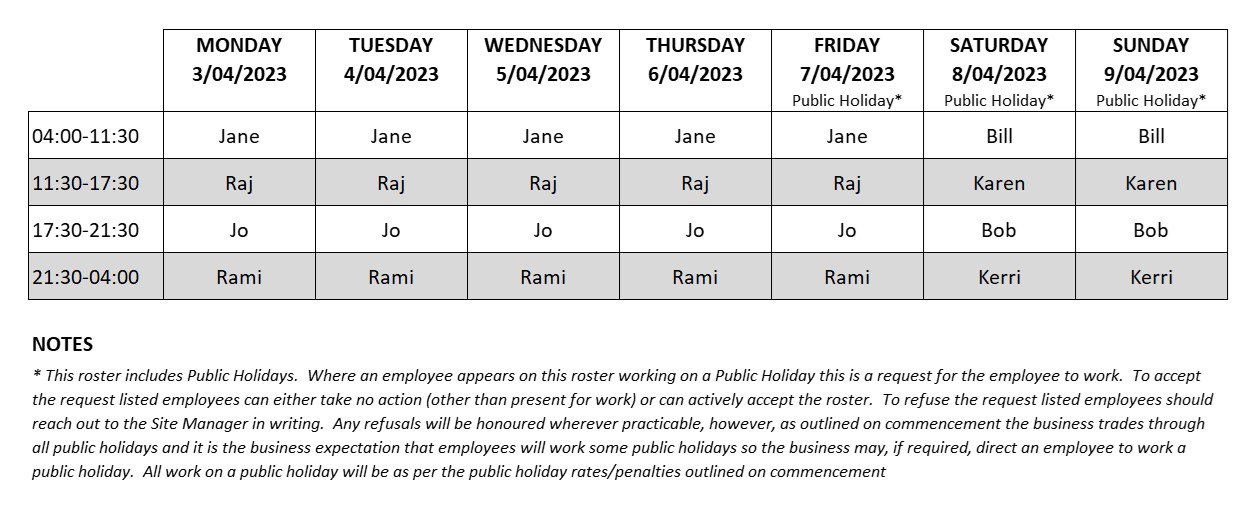
“For those members who are seeking to clarify the upcoming Easter Public Holidays, particularly those who have very stable rosters, but who do not actively accept rosters as part of a roster sign off process, it maybe advisable to put the clarification into a memo to staff”, explained Elisha.
Something like;
MEMO: Public Holiday Requests to Work
This note is to clarify that where an employee appears on a roster as working on a Public Holiday this is a request for the employee to work. To accept the request listed employees can either take no action (other than present for work) or can actively accept the roster. To refuse the request listed employees should reach out to the Site Manager in writing. Any refusals will be honoured wherever practicable, however, as outlined on commencement the business trades through all public holidays and it is the business expectation that employees will work some public holidays so the business may, if required, direct an employee to work a public holiday. All work on a public holiday will be as per the public holiday rates/penalties outlined on commencement.
Bottom Line
“Employees have a right to take the time at home, away from work, during a public holiday. That is the default position, that an employee will not work on a public holiday. Where a business is trading during a public holiday it is important that the business make the effort to make a proper ‘request’ to the employee to work on the public holiday. This allows the employee to internalise that it is a ‘request’ and that they have an avenue to say ‘no thanks I’d rather stay home’. This case has highlighted that even in instances where the business is confident that any requiring of the employee to work would be ‘reasonable’ it can not simply skip the ‘request’ step. When it comes to public holidays it is; Request, Refuse, Reasonably Direct – and each step is important and must be fully demonstrated” concluded Elisha.
More on Public Holidays
- Public Holiday Basics – https://acapmag.com.au/2022/12/getting-public-holidays-right/
- Public Holiday Swapping – https://acapmag.com.au/2023/03/easter-ramadan-diwali-and-public-holiday-swapping/
Here to Help
Through the year ACAPMA Employment Professionals are available to assist members via employment@acapma.com.au.
This article is general in nature and covers things to consider, implement and watch out for in your business. They are provided as general advice and you should seek further advice on your situation by calling 1300 160 270 and speaking to one of ACAPMA Employment Professionals its free for members. ACAPMA membership is affordable at only $810 per year for a single site and valuable with sites gaining HR advice support and representation as well as a raft of other benefits and discounts.
Visit: https://acapma.com.au/membership/ to apply for ACAPMA membership.
Elisha Radwanowski BCom(HRM&IR)
ACAPMA
