The Closing Loopholes Act , passed lat last year, introduced several important changes to the definition and practical requriements around casual employment. This changed definition and important changes to casual conversion pathways come into effect on 26 August 2024, but all employers should take the time now to understand the scope of these changes, and implement systems in their businesses to ensure compliance with the changed requriements.
Casual employment is different to permanent employment.
A permanent employee makes an agreement with the business on when they will work and that agreement is an ongoing future commitment that goes both ways. The employee agrees to turn up for work at the times that are agreed and the business agrees to pay the employee to work those times. This agreement does not depend on the business actually having work to do. If the business is experiencing low customer demand it is not able to tell a permanent employee that it will not be needed next week, there is a contract that the business must pay the employee for the agreed hours even if there is not work for the employee to do.
A casual employee is one that has registered available hours with the business, that the business calls on to fill its needs on an as needs basis. Some casual employees work some weeks and not other week, whereas some causal employees work every week.
What is different about a casual employee is that if there is a downturn in customer need the business can let the casual employee know that they will not be needed to work the next roster. On the employee side the casual employee can also let the business know that they will not be accepting an offered shift. No other notice is required on either side.
A casual is an employee who is offered work and may either accept or reject that work. There is not a firm advance commitment to offer work or to accept work. A casual employee receives a premium payment when compared to a permanent employee that provides for the lack of paid leave, notice and redundancy as well as the lack of advance commitment to employment.
The differences between casual and permanent staff mean that there are different requirements for engaging, managing and terminating casual staff that arise from the statutory definition and treatment of a casual employee in the law.
The Fair Work Act was amended from 26 August 2024 to include a new definition of a casual employee that shifts the focus from simply what the contract or offer says the employee is, to a focus on the actual characteristics of the employment relationship. In other words from a casual being a casual because the business calls them a casual and pays them as a casual to now be the employee is a casual only if they are called a casual, paid as a casual and the employment relationship confirms they are treated like and engaged as a casual.
This new definition places a premium on the actual reality of the relationship.
The definition itself is a simple one;
A person is a casual employee if the offer is made “on the basis that the employer makes no firm advance commitment to continuing and indefinite work”, and
the employee retains the right to accept or reject work, and the employee is described as a casual, and
the employee receives the appropriate casual rate (or base rate plus causal loading whatever is required) and
the reality of the relationship and real and practical substance of interaction affirms that the employment relationship is characterised by an absence of firm advance commitment to continuing and indefinite work.
The new definition opens a new pathway for Casual Conversion that is available immediately for employees who commence on or after 26 August 2024 as well as opening the option for Fair Work Commission to deem the employee to be permanent.
It is important to note that two different Casual Conversion requirements will operate at the same time until 26 February 2025 and apply to the employee not the business, based on when they commenced employment.
Which Casual Conversion Pathway applies?
The NEW Casual Conversion requirements will apply to all casual employees commenced on or after 26 August 2024.
The OLD Casual Conversion Process will still apply to employees who commenced before 26 August 2024. So employers will need to continue to actively send employees the old casual conversion letters until 26 February 2025 (26 August 2025 if the employer is a small business)
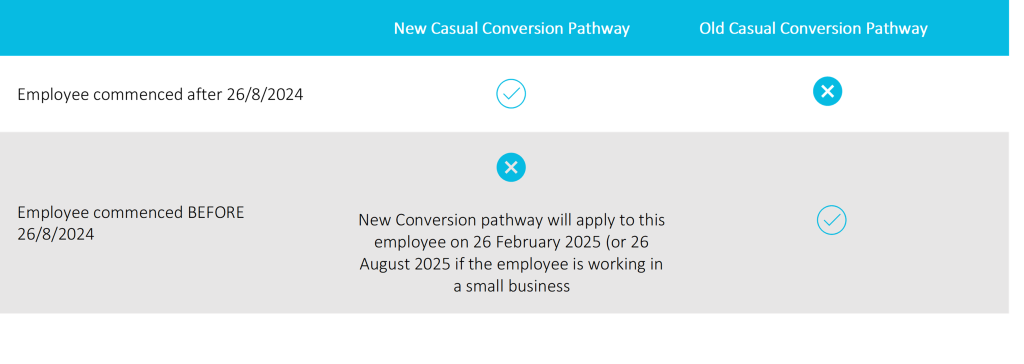
What is the difference between the Old and New Casual Conversion Pathways?
The main difference between the pathways to Casual Conversion is that the old pathway was employer driven, with the focus on the business making an offer (or not) to the employee to convert to permanent. Whereas the new pathway is employee driven with the employee Nominating to convert to permanent.

Under the new Casual Conversion pathway the employer is no longer required to write to the employee to either offer or explain why they are not offering for the casual employee to convert to permanent status. Instead the employer must issue the employee with the Casual Employee Information Statement (see below) at specific intervals and must respond if the employee issues the business with a Casual Conversion Notification that meets the minimum requirements.
If an employee;
- has been engaged for at least 6 months (12 months for a small business), and
- believes the reality of their employment is no longer consistent with causal employment, and
- has not in the last 6 months either requested conversion or been in a dispute about conversion,
they can issues the employer with a Casual Conversion Notice.
The employer;
- must respond within 21 days outlining the acceptance or rejection of casual conversion, and
- may reject the casual conversion because;
- the reality of the employment relationship is that the employee is still a casual
- there are fair and reasonable operational grounds for rejecting the conversion
- accepting the conversion would result in the employer failing to comply with other Commonwealth or State and Territory laws.
Under the new Casual Conversion pathway employees who are engaged as a casual will remain as a casual until one of the following occurs;
- their employment is converted to full time or part time in accordance with the casual conversion provisions, or
- their employment status is changes by the Fair Work Commission, or
- the employee accepts an alternative offer of employment .
The employee cannot be forced to change from casual to permanent against their will.
When there are disputes about casual conversion there are ne processes that allow the Fair Work Commission to hear those disputes.
Casual Employment Information Statement (CEIS)
It is a requirement of the law that all casual employees are provided with a copy of the Statutory Information Statements, specifically, The Fair Work Information Statement (FWIS) and the Casual Employment Information Statement.
These statements are updated regularly, so it is important that when sending the Statement the business use the most recent version.
The Fair Work Information Statement (FWIS) at https://www.fairwork.gov.au/employee-entitlements/national-employment-standards/fair-work-information-statement
The Casual Employment Information Statement (CEIS) at https://www.fairwork.gov.au/employee-entitlements/national-employment-standards/casual-employment-information-statement
The Casual Employment Information Statement must be provided to all casual employees at regular intervals;

More Information
ACAPMA members are reminded that they can access the advice support resources and representation of the ACAPMA Employment Professionals on this issue, or indeed any other employment issue, via employment@acapma.com.au.
HR Highlights are things to consider, implement and watch out for in your business. They are provided as general advice and you should seek further advice on your situation by contacting the ACAPMA Employment Professionals via employment@acapma.co.au its free for members. Click here to apply for ACAPMA Membership.
ACAPMA
